
Remembering the Gulag matters—Memory is our defense. Silence is the danger.
I spent half my life living and working in the Soviet Union, before walking away from everything I knew, traveling through Europe as a stateless refugee, and eventually rebuilding my life from the ground up in the United States. A few years ago, I paused to look back on my life and chronicled my entire journey in my memoir Camel from Kyzylkum.
In the Soviet Union, we all knew about the Gulag—an immense machinery of fear and punishment. It wasn’t just history; it was a system of terror that shaped how people thought, behaved, and survived.
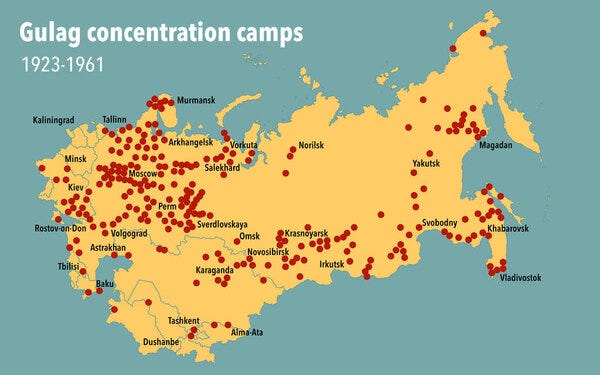
The Soviet Gulag system was one of the darkest engines of oppression in the 20th century—a vast network of forced-labor camps designed to break human bodies and human spirit alike. Millions were swallowed by this system: political dissidents, intellectuals, ordinary workers, entire families. Many never returned.
What made the Gulag especially horrifying was not only the brutality of the labor and the starvation-level conditions, but the way it turned cruelty into bureaucracy. A life could vanish with a forged accusation or a whispered complaint. Survival depended on luck as much as strength.
The Gulag stands as a chilling symbol of Soviet totalitarianism and the regime’s willingness to sacrifice millions of lives for political control and economic gain. Its legacy of state-sponsored terror continues to haunt Eastern Europe and the world.
While the Soviet Gulag system was officially dismantled, its legacy never disappeared. Modern Russian penal colonies often stand on the same sites, rely on forced labor for economic gain, and hold a growing number of political prisoners. Many observers now describe this reality as a “Gulag 2.0” — a revival of the forced-labor camp model amid rising political repression and an intensified effort to control historical memory.
Remembering the Gulag matters—not as distant history, but as a warning. Systems built on fear, dehumanization, and unchecked power can rise anywhere. And they always begin with small justifications, small persecutions, small erosions of truth.
Memory is our defense. Silence is the danger.
The U.S. detention sites as Alligator Alcatraz and Krome North Service Processing Center will be vindicated by History the same way as Gulag did.
From THOM HARTMANN recent post of 12/10/2025 (Alligator Alcatraz: How Tyranny Starts—With “Those People”):
Amnesty International’s new report on the U.S. detention sites Alligator Alcatraz and Krome is a warning flare for every American who believes in the Constitution, the rule of law, and the basic dignity of human beings.
We’ve seen governmental cruelty before in our history, but these facilities mark a new level of calculated dehumanization on U.S. soil, and Amnesty is calling it what it is: torture, enforced disappearance, and a deliberate system designed to break people.
What makes this report so chilling isn’t just the details, although they’re horrifying enough. It’s that the government has begun giving these places cute, theme-park-style nicknames like “Alligator Alcatraz” and “Cornhusker Clink,” as if they’re attractions instead of concentration-camp-style black sites.
Authoritarian regimes always begin by softening the language, making the abuses sound like logistics, law enforcement, or processing rather than cruelty. If you want to condition the public to accept state violence, you start with euphemisms.
Investigators found people packed into filthy tents and trailers where toilets overflowed onto the floors and into sleeping areas. Water was sometimes rationed. Food quality was lousy. Insects swarmed at all hours. Lights were left on day and night. Cameras reportedly pointed at showers and toilets, in clear violation of privacy and human dignity.
This wasn’t an accident. These were choices.
The so-called “box” at the Florida concentration camp may be the most grotesque example. It’s a two-by-two-foot outdoor metal cage where detainees, shackled and already vulnerable, were left in blistering Florida heat, exposed to mosquitos and biting flies, denied water, and forced to endure punishment sessions lasting up to 24 hours.
These are exactly the kinds of stress-position torture techniques our nation once condemned when used by dictatorships abroad. Today they’re being used in our name, by our government, on our soil.
At Krome, Amnesty documented prolonged solitary confinement, routine shackling even during medical transport, denial of legal access, and a pervasive system of intimidation and retaliation. Medical care was often delayed or unavailable. People needing lawyers were blocked from communicating with them.
This is not a “processing system”: it’s a punishment regime. It’s brutality done with your and my tax dollars and in our names.
The report makes clear that these are not isolated violations: they’re the design.
This administration has woven cruelty into policy, permitting state-run detention networks to operate as if constitutional rights simply evaporate when you cross a razor-wire perimeter.
The crisis for American democracy isn’t just that the camps exist; it’s that they’re being normalized, bureaucratized, branded, and replicated. Amnesty warns that DHS is already planning more such sites, using “emergency” authorities and no-bid contracts to create an extrajudicial detention network beyond the reach of meaningful oversight.
This is exactly how authoritarian systems evolve. They never begin with political opponents: instead, they begin with people the majority already sees as powerless. Immigrants. Refugees. The poor. Non-citizens. Those without family or money or social standing.
When the public tolerates a government treating one group of human beings as disposable, that system is inevitably expanded to inflict that same treatment on others — dissidents, politicians, people like you and me — whenever it becomes politically useful.
We’ve seen this in nation after nation that slid from democracy into authoritarianism. The first victims are always those considered “outsiders” or “threats to the order” the regime promised to maintain.
Once the public is desensitized to cages, beatings, disappearances, and secret courts, it becomes frighteningly easy to redirect those same tactics toward dissidents, journalists, labor leaders, activists, and political opponents.
This Amnesty International report isn’t just a humanitarian alarm bell: it’s a constitutional one.
When due process is suspended for one class of people, it’s suspended in principle for all. When the government can hide detainees in swamp camps with no legal representation, it’s already established the machinery necessary to detain anyone it wants to silence. When the public is conditioned to see cages and brutality and think “this is fine,” the moral system of a nation starts to collapse.
We forget that the Constitution doesn’t protect itself; it’s protected by norms, culture, public outrage, legal oversight, and a shared belief that the state doesn’t get to brutalize human beings no matter who they are.
When those norms erode, when brutality becomes invisible-but-known or acceptable, authoritarianism doesn’t arrive with a drumbeat. It arrives quietly. It arrives bureaucratically. It arrives through “temporary measures” and “emergency facilities” and “processing centers” set up for “those people over there.”
Amnesty is demanding the immediate closure of Alligator Alcatraz and any similar state-run black sites. They call for an end to emergency-authorized detention, a prohibition on outdoor punitive confinement, the restoration of access to legal counsel, real medical care, due process, judicial oversight, and a halt to no-bid construction of new concentration camps in America.
These aren’t radical demands. They’re the bare minimum for a nation that claims to believe in the rule of law.
Because if we let our government continue to create a network of secretive, cruel, extrajudicial detention facilities for one set of powerless people today, tomorrow it will inevitably turn those same systems against anyone who challenges their power.
That is how every authoritarian regime in history has done it.
And unless we stop it now, it’s how this one will, too.